
Betting Exchanges Explained: Back, Lay and Better Odds
You like the price, but the bookmaker will only take a small stake at it. An exchange starts from a different question: is there someone who wants the opposite side of your bet?
A betting exchange is a marketplace where you bet against other customers instead of a bookmaker. You back a result you expect, or lay one you do not, and the exchange matches you with someone who holds the opposite view. It does not set the price, so no bookmaker's margin sits in it; it charges exchange commission on your net winnings in a market instead. That is why prices can beat a bookmaker's, once the fee is counted. An exchange still has ceilings: the money waiting on the other side, your exposure limit and the fees. Whether you can use Betfair Exchange depends on your country, directly or through a broker's exchange tool with its own rules. Most bettors lose over time.
Who is on the other side of your bet?
At a bookmaker, that person is the bookmaker. It sets the price, takes your stake and pays you if you are right, so it also decides what it will accept from you. On an exchange the other side is another customer with the opposite opinion, and the exchange only introduces the two of you. Backing means betting that a result happens; laying means playing the bookmaker's part, so you win the backer's stake if it does not.
Betfair's terms name a few cases where it takes the other side itself, so "only other people" is a good summary, not an exact rule. One bet followed from both sides, with numbers, is in the walk-through of how betting exchanges work; this page is the map around it.
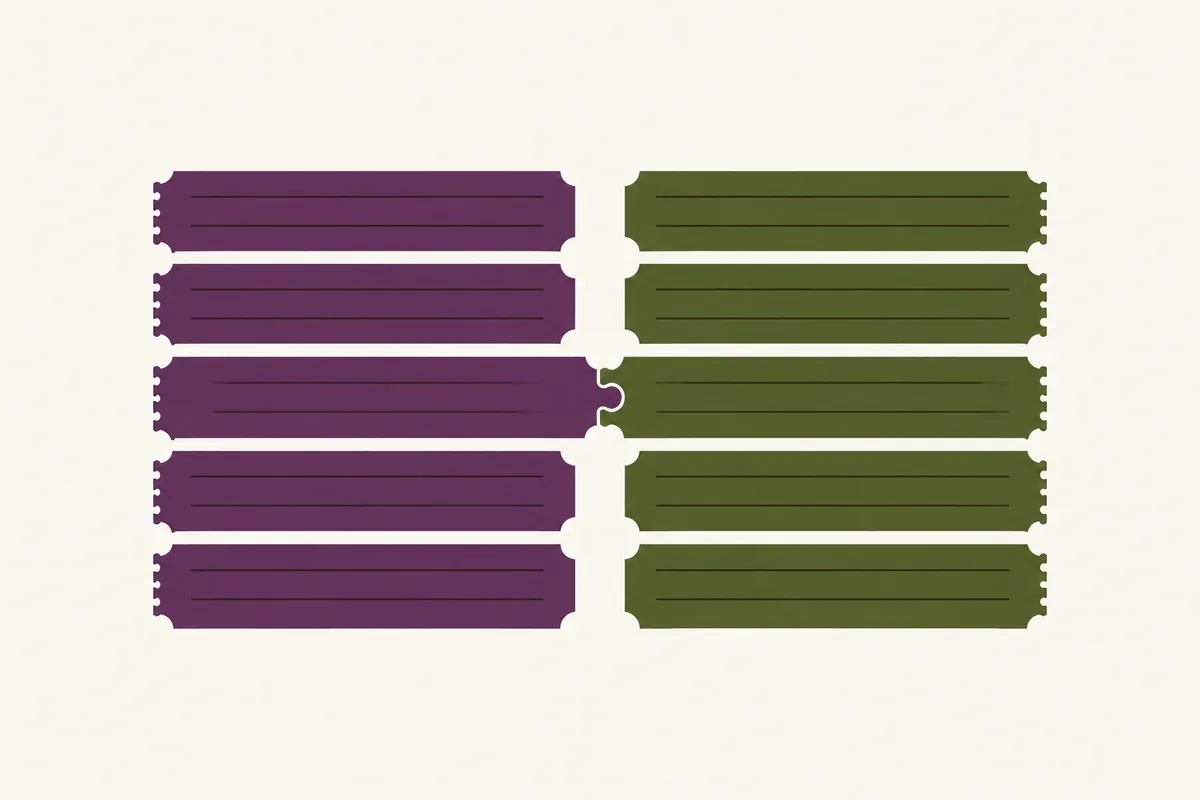
Schematic only: no prices, sizes or fees are shown.
What an exchange is not
It is not a bookmaker, and on Betfair it is not the Sportsbook either, though Betfair offers both. On the Sportsbook you bet directly against Betfair's own prices: it sets them, carries the risk, and reserves the right to refuse a bet or scale back a stake. This site covers the exchange only. (Betfair's terms add that, in some circumstances, a bet can win on one product and settle as a loser on the other, so check which one you are on.)
Nor does every exchange price beat a bookmaker's. Betfair's help page says exchange odds are generally higher than its Sportsbook's on single bets, but only the exchange charges commission on winnings. Whether that gap survives the fee is a sum, so let us do the sum.
Why an exchange price can beat a bookmaker's, and when it does not
A bookmaker's price carries a margin, a cut folded into the odds. Divide 1 by each decimal price in a market and add the results: anything over 100% is the margin. Two runners at 1.90 each give 52.63% plus 52.63%, or 105.26%, so the margin is about 5.3 points. (A margin never appears on a statement, which is its whole charm.) The margin calculator does the same sum for any market and shows what a price hides.
The exchange does not set the price, so there is no bookmaker's margin to add. The prices are other bettors' offers, and the fee comes later, from net winnings in a market. That is how an exchange can show 2.56 where a bookmaker shows 2.50, and why the fee goes into the sum before you call either one better.
The ceiling does not vanish; it changes owner.
What an exchange does limit
An exchange has ceilings too, just different ones. Depth is the first: Betfair calls liquidity the money waiting to be matched on a market, and its own guide says a Premier League match has huge liquidity on its main markets and a Swedish third-division match a lot less, so a bet can only be as large as the offers that meet it. (Cricket, not football, was the top exchange sport by matched money in 2023, by Betfair's own count: over £35bn.)
Fees are the second. Exchange commission comes off net winnings in a market, and very profitable accounts can meet an Expert Fee on top; check the current terms for the thresholds. Your own exposure limit also caps each bet.
The third ceiling is the operator. The exchange terms we read describe nothing like a bookmaker cutting a winner's stake, yet they let Betfair close an account without giving a reason after at least two weeks' written notice, and whether its maximum-winnings clause reaches exchange bets is unclear in them. Read Betfair's old "winners welcome" line as an intention, not a contract. What is real and what is hype about betting limits has the long version.
Other exchanges, and where each one stops
Betfair is not the only exchange. Each of the others has a catch, and the fees and country lists below change, so check the current terms before you fund anything.
| Exchange | What it charges | Where it stops |
|---|---|---|
| Betdaq | 2% exchange commission on net winnings for customers in the UK, Ireland, Gibraltar and Jersey. | 5% elsewhere, and it may apply other rates to certain profitable customers. Its accepted-country list is short: 26 countries in an archived 2024 version. |
| Smarkets | 2% on net profit per market, on its standard tier. | Its terms exclude residents of listed countries, among them Australia, France, Italy, the United States and the Netherlands. Over 1,500 bets or £1m a month you must opt into another tier, and over £25,000 net profit in 12 months puts you on 3%. It now describes itself as an exchange for prediction markets. |
| Matchbook | 2% on net profit for customers in the UK, Isle of Man, Channel Islands and Ireland. | 4% elsewhere. Its terms grant access for recreational betting at its discretion, and it may suspend accounts used commercially without approval, or accounts it considers attritional to the exchange. |
| Orbit Exchange | No flat rate stated; an archived 2018 betslip message says exchange commission is charged on net profit per market. | Sold through agents and brokers that call it "powered by Betfair". We found no Orbit, Betfair or Flutter page confirming that, and could not verify its operator, licence or country list. |
Mollybet (a trading platform, closed to residents of the USA, UK, Hong Kong and Singapore), Kalshi and Polymarket (event contracts, each with its own rules and changing country list) also turn up in broker lists. They are different products: check your country first.
How you get in, and where each route stops
One question overrules everything below: is betting on exchanges allowed where you live? If not, stop here and check local law.
Route one, a Betfair account of your own. It works only if Betfair serves your country. Its terms call the countries it does not serve Prohibited Territories, list a long run of them (Australia, France, Germany and the United States among them) and end with "any other country with a comparable legal situation". A listed country is one betfair.com does not serve, and some of them have a local Betfair operation. The list changes, and we found no Betfair list of the countries it does serve, so check the current terms and your local law. The step-by-step guide to getting in gives the order in which to try things, and the registration guide covers sign-up and ID checks.
Route two, a broker's exchange tool. The brokers listed below each offer one, as a commercial arrangement under the broker's own terms. It is not a Betfair account, and nothing we read says it lets residents of a Prohibited Territory use Betfair.
Each broker sets its own rules on who can join, what it charges and what it asks to see before paying out. BetInAsia, MadMarket and Sportmarket all exclude the UK and the USA in their terms (MadMarket adds Australia, Sportmarket France). AsianConnect's help centre lists the USA and China as restricted, though its sign-up form disagrees on some countries, and we could find no Betdaq, Matchbook, Smarkets or Mollybet listing on its pages. Check the current terms, then compare the four in the broker comparison.
Route three, another exchange from the table above, if one of them serves your country. Judge it by what is queued on the market you want, not by the name.
If Betfair serves your country, I would go direct and skip the broker pages: one set of rules and ID checks instead of two. A broker is worth a look when you want several exchanges behind one login. It does not lift Betfair's country list; its own list and your local law still apply. The access route finder shows which routes fit you.
Questions people ask
What is a betting exchange?
A marketplace where customers bet against each other, not against a bookmaker. One backs a result, another lays it, and the exchange matches them and charges exchange commission on net winnings.
How does a betting exchange work?
You offer a price and a stake, or take one already offered. If an opposite offer at that price exists, the two match; if not, yours waits unmatched. A £20 bet followed step by step shows the order book, the matching and the fee.
Are exchange odds always better than a bookmaker's?
No. Betfair says exchange odds are generally higher than its Sportsbook's on single bets, before exchange commission, and the fee rate depends on your country and package. In the worked example a bookmaker's 2.50 needs about 2.53 on the exchange at a 2% fee and about 2.60 at 6.5%.
Do exchanges limit winning bettors?
The Betfair exchange terms we read describe nothing like a bookmaker cutting a winner's stake, but ceilings remain: market depth, fees and your own exposure limit. Betfair can also close an account without giving a reason after at least two weeks' written notice. The page on betting limits separates fact from marketing.
Where next depends on what stopped you. If the exchange says no, the Betfair access section is the place to start. If a sum here looked doubtful, the calculators let you rerun it with your own rate.